
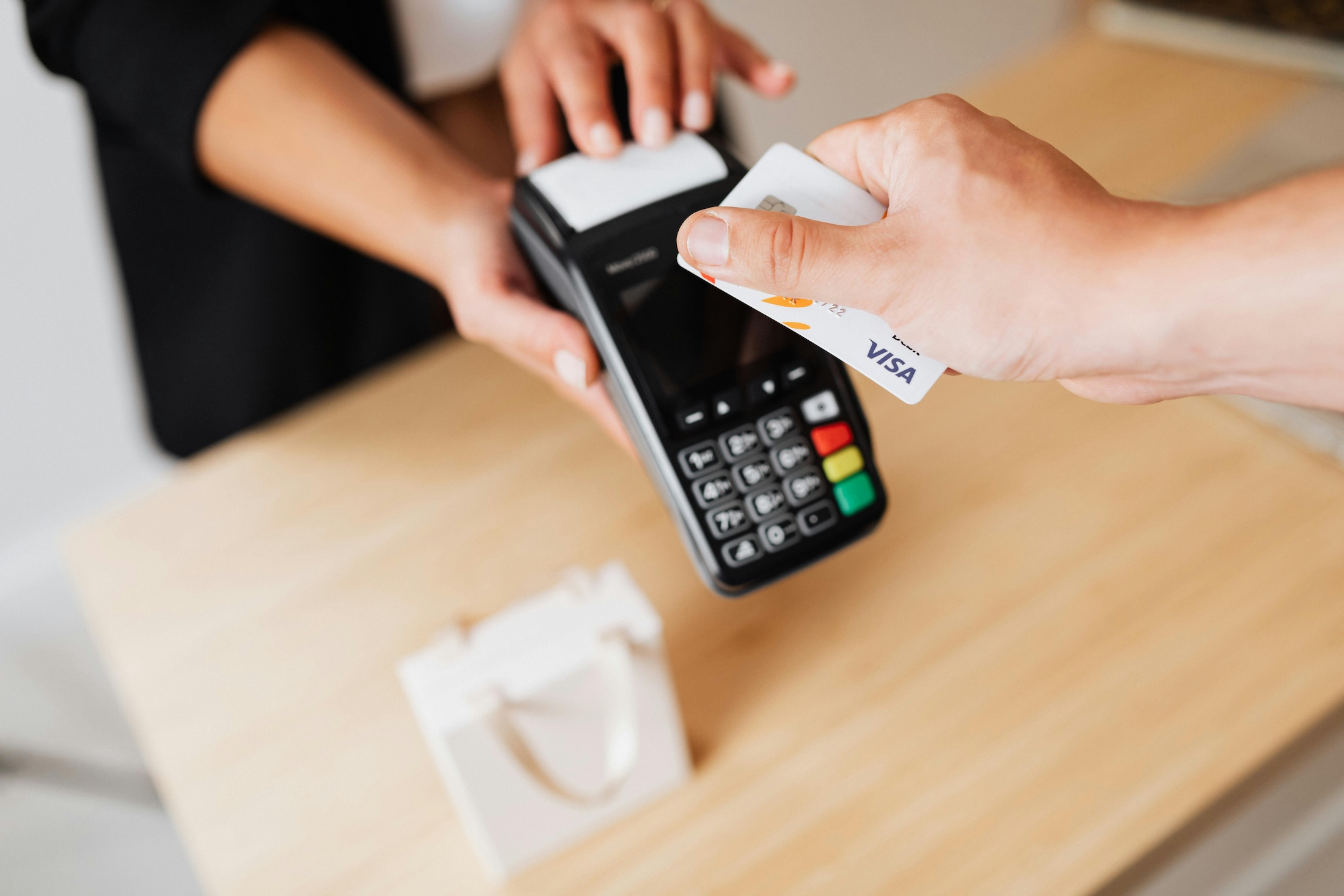
Every time a customer taps their debit card at your terminal, that transaction gets sent through a payment network. Which network it goes through determines what you pay in merchant fees.
By default, most contactless debit payments route through Visa or Mastercard as they are the international card networks. That’s simply how the system is configured out of the box. But in many cases, there’s a cheaper option available: the domestic eftpos network.
Least cost routing (LCR) lets you choose it.
It’s one of the more straightforward ways for Australian businesses to reduce card payment costs. Here’s how it works, who benefits most, and what to do if you’re not using it yet.
The basics: three networks, different rates
Most debit cards issued by Australian banks are dual-network cards. If you look at a customer’s debit card, you’ll typically see both a Visa or Mastercard logo on one side and an eftpos logo on the other. That card can process a transaction through either network.
The three networks available for domestic debit transactions are:
- eftpos — Australia’s domestic debit network, owned by Australian Payments Plus (AP+)
- Visa — processes transactions through its global network
- Mastercard — processes transactions through its global network
Each network charges a different rate. And the rate difference matters: merchant service fees on eftpos transactions are roughly half those charged on Visa and Mastercard debit transactions.
The problem is that contactless tap-and-go payments default to whichever network the card issuer, usually the customer’s bank, has set as the priority. In practice, that almost always means Visa or Mastercard. Without LCR, the merchant has no say in the matter.
Least cost routing changes that. It gives you, as the merchant, the ability to choose which network your eligible debit transactions are routed through, and to route them toward the cheapest option.
How LCR actually works
When a customer taps a dual-network debit card on your terminal, your payment provider evaluates the available networks and routes the transaction through whichever one costs less — typically eftpos for card-present transactions.
The customer sees no difference. The tap works exactly as it would otherwise. The only thing that changes is which network processes the transaction on the back end, and consequently, what you’re charged for it.
LCR is an opt-in feature. Once enabled, it runs automatically, so you don’t need to manually select anything for each transaction, and your staff don’t need to do anything differently.
What it applies to (and what it doesn’t)
LCR only works in specific circumstances. Before you opt in, it’s worth understanding the scope clearly.
LCR applies to:
- Contactless (tap-and-go) transactions on dual-network debit cards
- Card-present, in-person payments at the terminal
LCR does not apply to:
- Credit card transactions as these run on a single network regardless
- Digital wallet payments (Apple Pay, Google Pay, Samsung Pay). These currently route through the international networks by default, though the RBA has pushed for this to change
- Debit card transactions where the card is inserted or swiped rather than tapped
- Online (card-not-present) transactions, though some providers are now beginning to extend LCR capability to e-commerce
Given that debit cards account for the large majority of card payments in Australia, and most debit transactions today are contactless, the eligible transaction pool is substantial for most businesses.
Does it actually save money?
Yes, but not uniformly, and the savings depend on your transaction profile.
The key variable is your average transaction value.
eftpos charges on a flat cents-per-transaction basis. Visa and Mastercard charge a percentage of the transaction value. That structure means:
- For higher average transaction values, eftpos’s flat fee is almost always cheaper. A business with average transaction amounts of $50–$150 can save meaningfully on every routed transaction.
- For lower average transaction values, say, a café where most payments are under $10, the flat eftpos fee may actually cost more than a percentage-based Visa or Mastercard rate on the same transaction.
An example
Say your payment provider charges 1.8% for Visa/Mastercard debit transactions and a flat 20 cents for eftpos transactions.
- On a $15 transaction: Visa/Mastercard costs $0.27. eftpos costs $0.20. LCR saves $0.07.
- On a $60 transaction: Visa/Mastercard costs $1.08. eftpos costs $0.20. LCR saves $0.88.
- On a $6 transaction: Visa/Mastercard costs $0.11. eftpos costs $0.20. LCR would cost more, so for this transaction type, not routing via eftpos is the better call.
This is why some providers offer threshold routing: the ability to set a dollar value above which transactions route to eftpos, and below which they stay on Visa/Mastercard. It lets you capture savings on larger transactions while avoiding overpaying on smaller ones.
Your actual numbers will depend on the rates your payment provider charges for each network. The starting point is requesting a clear breakdown of what you’re currently paying per network.
Who benefits most
LCR is most impactful for businesses that:
- Have higher average transaction values (retail, trade services, health and wellness, professional services)
- Process a high volume of debit card transactions (the savings per transaction are small, but they accumulate quickly at scale)
- Are currently on interchange-plus or itemised pricing (if you’re on a flat blended rate, your provider may absorb the network difference rather than passing it through to you; worth confirming)
- Don’t already have a surcharge in place to offset fees (with the surcharge ban arriving on 1 October 2026, tools like LCR become more relevant as a cost management alternative)
Businesses with low average transaction values (high-frequency, low-value hospitality, such as quick-service cafés) should model their specific numbers before opting in, or explore threshold routing rather than a blanket EFTPOS-first approach.
LCR and the October 2026 reforms
The RBA’s October 2026 changes in lowering interchange fee caps and banning card surcharges make LCR more relevant.
With surcharges gone as a cost recovery mechanism, the focus shifts to managing the underlying cost of card acceptance. LCR works alongside the interchange cap reductions rather than being replaced by them: interchange caps reduce the ceiling on what networks can charge, while LCR lets you actively choose the cheaper network within that new cost structure.
How to enable it
Enabling LCR is generally straightforward:
- Check with your payment provider that LCR is available on your terminal and pricing plan. Not all providers have implemented it across all plans.
- Request an itemised rate breakdown — you need to know what you’re currently paying for eftpos transactions versus Visa/Mastercard debit transactions to assess whether routing will save you money, and by how much.
- Choose your routing preference — full eftpos routing, full Visa/Mastercard routing, or a threshold-based approach, depending on your transaction profile.
- Opt in — once configured, LCR is automated. No ongoing action required.
There should be no activation fee and no change to the customer experience. Most merchants who enable it report no difference in how transactions feel at the counter.
A word on awareness
Least-cost routing has been available to most Australian businesses for several years — the RBA has actively promoted it, and the major banks have been required to make it available to eligible small-business customers. But uptake has lagged well behind the RBA’s targets, largely due to a lack of awareness about how it works and whether it’s worth enabling.
If you haven’t had this conversation with your payment provider, it’s worth having. The savings won’t be life-changing for every business, but for businesses processing a meaningful volume of higher-value debit transactions, they add up over time without requiring any change to how you operate.
Venue Smart and least cost routing
Venue Smart’s EFTPOS terminals support least cost routing for eligible in-store transactions. Our recurring payments platform also brings LCR capabilities to billing and subscription payments — an extension of the technology that’s less common but valuable for businesses that collect regular payments from customers.
If you want to understand whether LCR makes sense for your transaction profile, or you’re reviewing your overall merchant fee setup ahead of the October 2026 changes, get in touch with the Venue Smart team.